

Two players sit at different live baccarat tables with the same $10 betting rule. One chooses Speed Baccarat, where the cards appear almost immediately and the next betting timer starts within seconds. The other chooses Squeeze Baccarat and watches each card being revealed slowly before the result is confirmed.
If both tables use the same decks, drawing rules and paytable, their odds on an individual hand are the same. The important difference is that the Speed Baccarat player may place far more bets during the same one-hour session.
Faster play does not secretly reduce the RTP or change which cards are dealt. It can, however, increase turnover, shorten decision time and raise the expected cost per hour. This Speed Baccarat vs Squeeze Baccarat comparison separates the real mathematical difference from the drama of the card reveal.
Table of Contents
The Short Answer
Game pace does not change the odds per hand. When the rules and payouts match, Speed Baccarat and Squeeze Baccarat carry the same house edge. Speed Baccarat can still cost more per hour because it lets the player complete more wagers in the same amount of time.
Both versions normally follow the same basic drawing process:
- Player and Banker each receive two cards.
- A third card may be drawn automatically according to the baccarat tableau.
- The hand finishing closest to nine wins.
- Players do not decide whether either hand draws or stands.
Squeezing a card cannot improve the chance of Player, Banker or Tie. Dealing the cards faster cannot make a losing card turn into a winner. The real difference is exposure: 100 bets create twice the turnover of 50 equal-sized bets.
What Is Speed Baccarat?
Speed Baccarat is a shortened live-dealer format that removes much of the ceremony between betting, dealing and settlement. Cards are usually dealt face-up, totals are displayed immediately and a new betting window begins soon after the result.
On a typical Speed Baccarat table:
- The betting timer is short.
- Cards are revealed without a squeeze sequence.
- Player and Banker totals are calculated automatically.
- Third-card rules are applied without player decisions.
- Winning bets are settled quickly.
- Repeat Bet may carry the same wager into the next round.
Some major-provider Speed Baccarat tables complete a full round in approximately 27 seconds, often with around 12 seconds available for betting. The exact timer can differ by provider, studio and table configuration.
Theoretical pace at 27 seconds per round
3,600 seconds ÷ 27 seconds = approximately 133 rounds per hour
Actual completed bets will usually be lower because players may miss timers, pause, change tables or experience connection delays.
What the Word “Speed” Does Not Mean
Speed Baccarat does not normally introduce:
- Higher-value cards
- Different third-card decisions
- A more likely Banker result
- A lower chance of Tie
- A predictable baccarat road
- More control over the result
The cards still decide the winner. Speed only reduces the time between betting opportunities.
What Is Squeeze Baccarat?
Squeeze Baccarat recreates the slow card-reveal ritual associated with traditional Asian baccarat rooms. Instead of turning each card face-up immediately, the dealer gradually bends or peels the edge to expose the suit, pips and final value.
Some versions are controlled entirely by the dealer. In Control Squeeze or interactive versions, a player may click, swipe or drag an on-screen mask to reveal a real card captured by cameras built into the table.
The interaction creates suspense, but by the time the squeeze begins:
- The betting window has normally closed.
- The cards have already been dealt or selected.
- The drawing rules are fixed.
- The card value cannot be changed.
- Revealing a different corner provides no betting advantage.
Why Squeeze Baccarat Takes Longer
A squeeze table may spend additional time on:
- Selecting which hand will be revealed first
- Switching between close-up camera angles
- Slowly exposing each card
- Allowing an interactive reveal
- Repeating the squeeze when a third card is drawn
Round duration varies considerably. A quick dealer squeeze may be only slightly slower than standard baccarat, while a controlled or interactive table can take much longer. Squeeze Baccarat is therefore a presentation choice rather than a separate winning strategy.
Speed Baccarat vs Squeeze Baccarat Comparison
| Feature | Speed Baccarat | Squeeze Baccarat |
|---|---|---|
| Main purpose | Complete rounds quickly | Create suspense during the reveal |
| Card presentation | Usually face-up immediately | Revealed slowly by dealer or interface |
| Typical pace | About 27 seconds on some tables | Variable and generally slower |
| Betting window | Often short | Usually offers more breathing room |
| Decision that changes the cards | None | None |
| House edge | Determined by the paytable | Determined by the paytable |
| Main practical risk | High hourly turnover | Overvaluing the squeeze ritual |
| Best suited to | Players who prefer continuous action | Players who enjoy slower presentation |
The table name alone cannot confirm mathematical value. A Speed Baccarat game with standard 5% Banker commission can have a different RTP from a no-commission Squeeze Baccarat table. That difference comes from the paytable—not from the speed or card animation.
Does Game Speed Change the Odds?
Assume two tables use all of the following:
- Eight decks
- Standard baccarat drawing rules
- Banker pays 0.95 to 1 after commission
- Player pays 1 to 1
- Tie pays 8 to 1
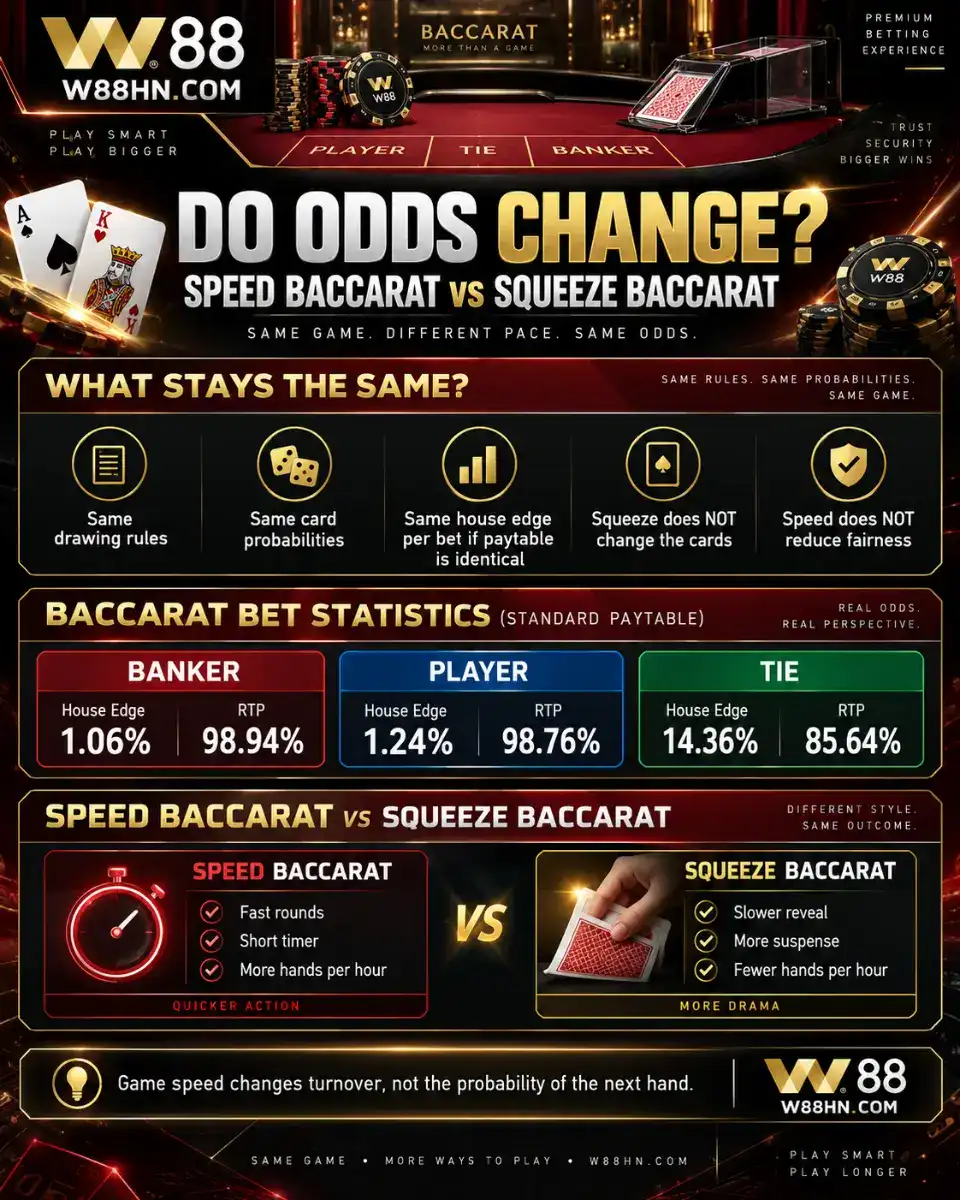
Under these matching conditions, the approximate house edge per wager is the same at Speed Baccarat and Squeeze Baccarat.
| Main Bet | Common Payout | Approximate House Edge | Approximate RTP |
|---|---|---|---|
| Banker | 0.95 to 1 | 1.06% | 98.94% |
| Player | 1 to 1 | 1.24% | 98.76% |
| Tie | 8 to 1 | 14.36% | 85.64% |
Same Number of Hands, Same Expected Cost
Suppose a player wagers $10 on Banker for exactly 100 hands.
Total turnover: $10 × 100 = $1,000
Approximate expected loss: $1,000 × 1.06% = $10.60
The expected mathematical cost is approximately $10.60 whether those 100 hands are completed at a fast table or a slow squeeze table. Speed only changes how long it takes to reach the 100th wager.
How Faster Play Changes Hourly Risk
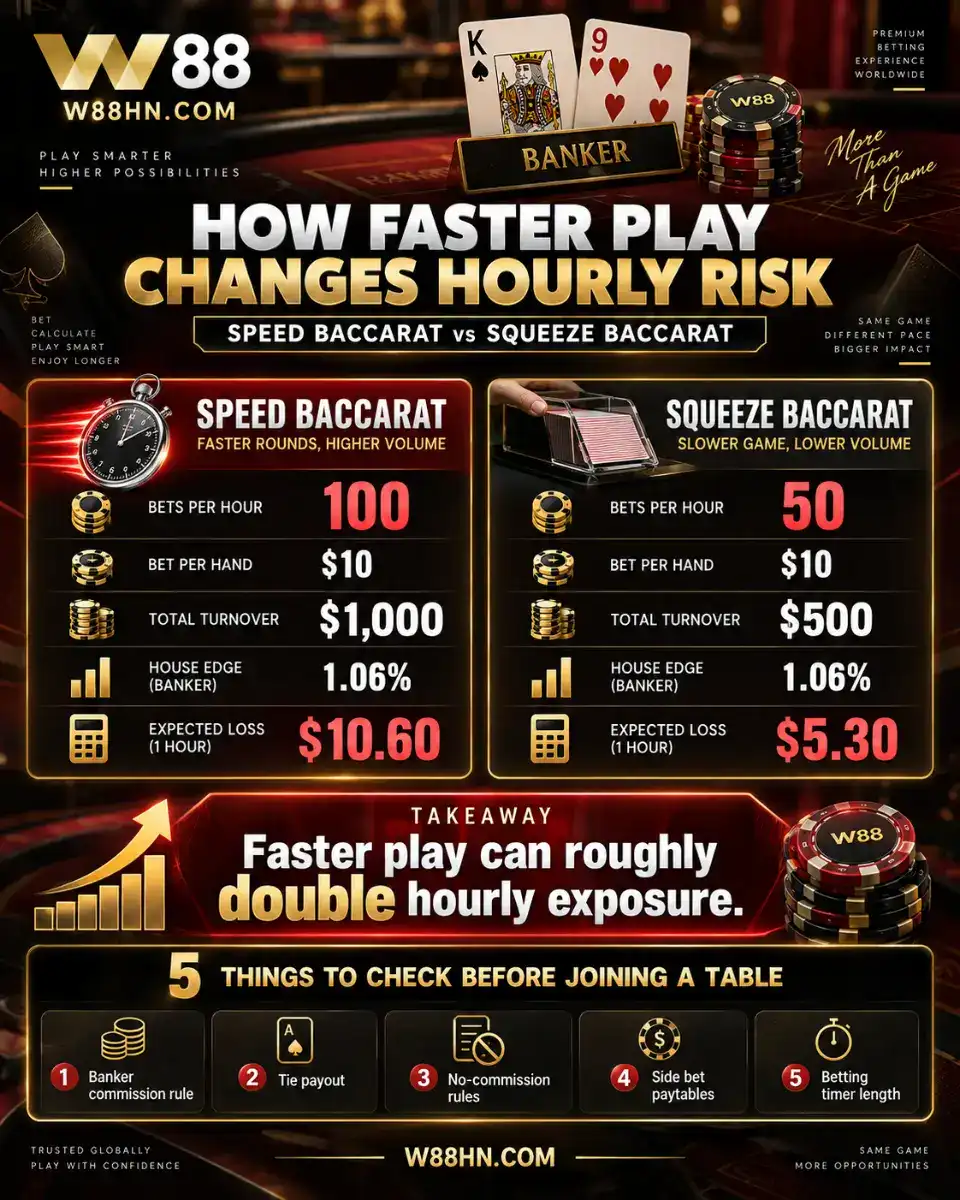
Many players manage a session by time rather than by number of bets. They decide to play for one hour without setting a hand limit. In that situation, game speed becomes financially important because more completed rounds produce more turnover.
Consider this simplified comparison:
- Bet size: $10 per hand
- Main wager: Banker
- House edge: approximately 1.06%
- Speed session: 100 completed bets
- Squeeze session: 50 completed bets
| One-Hour Example | Speed Baccarat | Squeeze Baccarat |
|---|---|---|
| Bets completed | 100 | 50 |
| Bet per hand | $10 | $10 |
| Total turnover | $1,000 | $500 |
| Approximate expected loss | $10.60 | $5.30 |
The Speed player did not receive worse odds. The player simply wagered twice as much during the hour.
The Same Effect Applies to Every Bet Type
| Bet Type | House Edge | Expected Loss on $1,000 Turnover | Expected Loss on $500 Turnover |
|---|---|---|---|
| Banker | 1.06% | $10.60 | $5.30 |
| Player | 1.24% | $12.40 | $6.20 |
| Tie at 8 to 1 | 14.36% | $143.60 | $71.80 |
These figures are long-run averages, not session predictions. A player can finish ahead or lose considerably more during a short session. The calculation only shows how increased turnover raises expected exposure.
Turnover Is Not the Same as Deposit
A $100 deposit can create much more than $100 of turnover when returned stakes and previous winnings are wagered again. Making 100 wagers of $10 produces $1,000 in action even if the starting balance was only $100.
Players funding live tables with cryptocurrency should also separate casino processing time from blockchain transfer time. Our explanation of USDT casino deposits and transaction limits covers network selection, fees and confirmation checks before funds are sent.
Can Squeezing the Cards Affect the Result?
No. Squeezing changes when the player sees the card, not which card exists.
Imagine that the next card is a seven. Revealing the first pip slowly, swiping from the left side or letting the dealer turn it over immediately cannot change that seven into another value. The squeeze creates a feeling of control because the player participates in the reveal, but mathematically it is like slowly opening an envelope that already contains the result.
Can Experienced Players Read the Card Early?
Some players identify a card before the full reveal by counting pips or recognizing the position of suit symbols. That can make the squeeze more entertaining, but it does not create a betting advantage because wagers are normally closed before the reveal begins.
Knowing the card a few seconds before the final display is useless if no new bet can be placed or changed.
Does a Long Squeeze Mean a Strong Card?
No. The length and drama of the reveal do not indicate whether the result will be strong. A long squeeze can reveal a zero, while an instant deal can produce a natural nine. Presentation builds tension; it does not communicate probability.
Paytable Differences That Really Change RTP
Although pace does not change the odds, tables with different names may use different payout rules. This is the most important detail to check before betting.
Standard Commission Baccarat
A traditional table normally pays:
- Player win: 1 to 1
- Banker win: 0.95 to 1 after 5% commission
- Tie: commonly 8 to 1 or 9 to 1
Under the common eight-deck 8-to-1 Tie paytable, Banker carries an approximate 1.06% house edge and Player approximately 1.24%.
No-Commission Baccarat
Some Speed or Squeeze tables advertise no Banker commission. This does not mean the casino has removed its mathematical advantage. A common Super 6 rule pays only 0.5 to 1 when Banker wins with six, while other formats may push a particular Banker result.
The interface feels simpler because commission is not deducted after every normal Banker win, but the altered settlement rule changes the RTP.
Tie and Side-Bet Payouts
A Tie paying 9 to 1 is mathematically better than one paying 8 to 1. Player Pair, Banker Pair, Perfect Pair, Dragon Bonus and Lucky 6 also have independent payout tables and much higher variance than the main Player or Banker wagers.
High headline payouts should never be compared without their hit rates and house edges. Our detailed Dragon Bonus vs Lucky 6 comparison shows why a 30-to-1 prize is not automatically better value than a side bet paying 23 to 1.
Five Checks Before Joining a Table
- Confirm whether Banker pays 0.95 to 1, even money or half on a winning six.
- Check whether Tie pays 8 to 1 or 9 to 1.
- Read the exact payouts for every side bet you intend to use.
- Check the length of the betting window.
- Make sure the minimum and maximum stakes fit the planned bankroll.
Common Mistakes at Fast Baccarat Tables
Chasing a Missed Bet
A short timer can close before a player confirms a wager. The dangerous reaction is doubling the next bet because the missed selection would have won. A wager that was never placed did not win or lose, and the next hand remains a separate result.
Leaving Repeat Bet Enabled
Repeat Bet is convenient, but it can place another wager before the player has reviewed the balance or table conditions. This becomes more noticeable in Speed Baccarat because the next round starts quickly.
Treating Small Side Bets as Free Extras
A $10 Banker wager with two $2 side bets creates $14 of turnover per hand. Across 100 rounds, those small side wagers add $400 of extra action. Because many baccarat side bets have a much higher house edge than Banker or Player, they can account for a disproportionate share of the expected cost.
Assuming a Fast Streak Must Reverse
Ten rapid Banker losses can feel unusual because they occur within a few minutes. The compressed time does not make Player or Banker due. Baccarat roads record previous outcomes; they do not force the next cards to balance the pattern.
Increasing Stakes to Make the Session More Exciting
Moving from $10 to $20 per hand doubles turnover immediately. Combining a higher stake with more frequent rounds is the quickest way to increase financial exposure.
Which Version Is Better for You?
Neither format is automatically better. The practical choice depends on how comfortably the player can manage pace, attention and bankroll.
Speed Baccarat May Suit You If:
- You already understand the betting areas and payout rules.
- You prefer face-up cards and minimal waiting.
- You can make decisions without rushing.
- You set a fixed number of hands.
- You are comfortable ignoring unnecessary side bets.
- Your connection is stable enough for a short timer.
Squeeze Baccarat May Suit You If:
- You enjoy the traditional card-reveal ritual.
- You prefer a slower live-casino experience.
- You want more time between results.
- You are still learning totals and drawing rules.
- You find rapid betting timers uncomfortable.
- Presentation matters more than completing many rounds.
A Better Limit for Speed Baccarat
Setting only a time limit may not control turnover effectively at a fast table. A stronger plan combines session time, number of hands and fixed stake size.
Final Verdict
Speed Baccarat vs Squeeze Baccarat is primarily a comparison of pace and presentation—not winning probability.
When both tables use the same number of decks, drawing rules and payouts:
- Player odds remain the same.
- Banker odds remain the same.
- Tie probability remains the same.
- Squeezing does not influence the cards.
- Faster dealing does not lower the RTP per hand.
The real difference: Speed Baccarat fits more wagers into a session. More wagers create more turnover, and more turnover increases expected hourly loss even when the house edge per hand is unchanged.
The smartest comparison is therefore not simply fast versus slow. Check the Banker commission, treatment of a winning Banker six, Tie payout and side-bet rules first. Those details determine the real odds. After that, choose the pace that allows you to remain calm, monitor the balance and avoid rushed decisions.
Responsible Gambling
Baccarat outcomes cannot be controlled by game speed, card squeezing, road patterns or staking systems. Set spending and hand limits before playing, never chase losses and use time-out or self-exclusion tools if gambling stops feeling recreational.
Frequently Asked Questions
Does Speed Baccarat have worse odds than Squeeze Baccarat?
Not when the decks, drawing rules, commission and payouts are identical. Speed Baccarat may cost more per hour because the player can complete more bets during the same period.
Does squeezing the cards change the baccarat result?
No. The cards have already been dealt or selected before they are revealed. Squeezing only changes when their values become visible.
How long does a Speed Baccarat round take?
Some major-provider tables complete a round in approximately 27 seconds and offer a betting window of around 12 seconds. Exact timing varies by provider and table.
How many Speed Baccarat hands can be played per hour?
A continuous 27-second cycle has a theoretical ceiling of approximately 133 rounds per hour. Real players normally complete fewer bets because of pauses, missed timers, connection delays and table changes.
Is Banker still the lowest-edge main bet?
On a standard eight-deck table with 5% commission, Banker has an approximate house edge of 1.06%, compared with about 1.24% for Player. No-commission versions may settle a winning Banker six or another result differently, so check the rules first.
Is Squeeze Baccarat better for beginners?
It can be easier to follow because the slower presentation provides more time to review totals, stakes and balance. Beginners must still check whether the table uses standard commission or no-commission rules.
Can baccarat roads predict the next Speed Baccarat result?
No. Roads display completed outcomes but do not force a streak to continue or reverse. A faster sequence does not make the next Player, Banker or Tie result predictable.
Does Speed Baccarat increase the house edge?
Speed alone does not increase the house edge per wager. It increases the number of betting opportunities. More bets made at the same negative expectation increase the expected cost of a time-based session.
Are all Squeeze Baccarat tables no commission?
No. Some tables use the standard 5% Banker commission, while others use no-commission rules with a reduced payout or push on a specific Banker result. Always open the paytable before betting.