

Dragon Bonus and Lucky 6 often appear next to the main betting areas, but they reward completely different results. Dragon Bonus pays according to how convincingly the selected hand wins. Lucky 6 waits for one narrow event: the Banker must win with a final total of six.
The advertised payouts make both bets look attractive. Dragon Bonus can reach 30 to 1, while some Lucky 6 tables pay 23 to 1. Those headline numbers do not reveal how often each result occurs, how the smaller wins are paid or how much value the house keeps over time.
There is another detail worth checking before any wager is placed: Lucky 6 does not have one universal paytable. A three-card Banker 6 may pay 23 to 1 at one table and only 20 to 1 at another. That small-looking change has a large effect on the house edge.
Table of Contents
The Short Answer
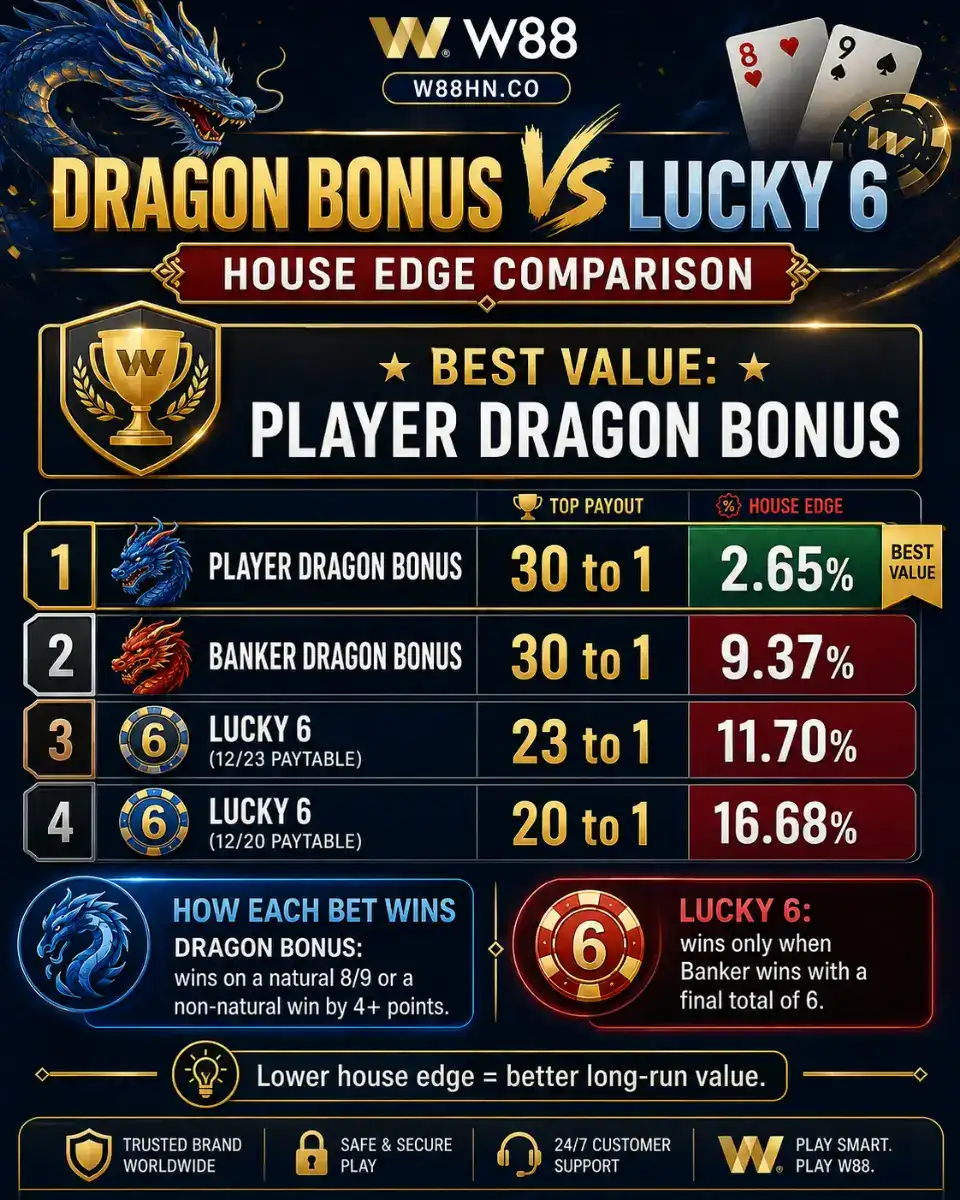
Under a common eight-deck paytable, Player Dragon Bonus is mathematically the strongest choice in this comparison.
Its estimated house edge is approximately 2.65%. Banker Dragon Bonus rises to about 9.37%. Lucky 6 has an estimated house edge of 11.70% when a three-card win pays 23 to 1, but this increases to roughly 16.68% when the same result pays only 20 to 1.
| Side Bet | Common Top Payout | Approximate House Edge |
|---|---|---|
| Player Dragon Bonus | 30 to 1 | 2.65% |
| Banker Dragon Bonus | 30 to 1 | 9.37% |
| Lucky 6 with 12/23 paytable | 23 to 1 | 11.70% |
| Lucky 6 with 12/20 paytable | 20 to 1 | 16.68% |
What the percentages mean: A 2.65% house edge does not mean every $100 session will lose exactly $2.65. It describes the average mathematical cost across a very large number of wagers.
What Dragon Bonus Actually Rewards
Dragon Bonus is normally offered as two independent wagers:
- Player Dragon Bonus
- Banker Dragon Bonus
The chosen hand must either win with a natural eight or natural nine, or win without a natural by at least four points.
A natural is a total of eight or nine made with the first two cards. If the Player has a natural nine and defeats the Banker, a Player Dragon Bonus wins at even money.
For a non-natural result, the final winning margin determines the payout.
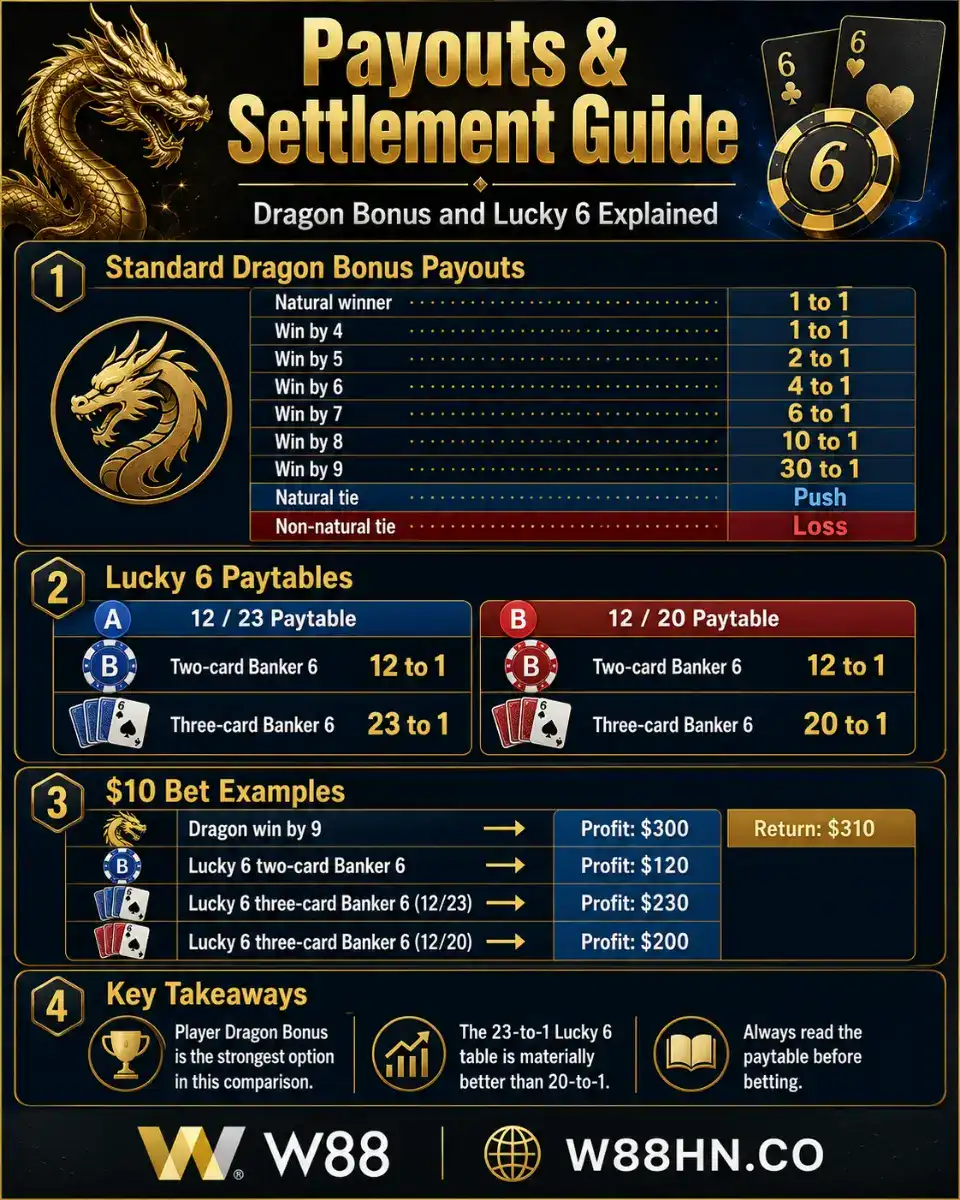
Standard Dragon Bonus Payouts
| Winning Result | Payout |
|---|---|
| Natural winner | 1 to 1 |
| Non-natural win by 4 points | 1 to 1 |
| Non-natural win by 5 points | 2 to 1 |
| Non-natural win by 6 points | 4 to 1 |
| Non-natural win by 7 points | 6 to 1 |
| Non-natural win by 8 points | 10 to 1 |
| Non-natural win by 9 points | 30 to 1 |
| Natural tie | Push |
| Non-natural tie | Loss |
The detail many players miss: Choosing the winning hand is not always enough. If Player wins 7–5 without a natural, the normal Player wager wins, but Player Dragon Bonus loses because the margin is only two points.
Dragon Bonus is not a higher-paying replacement for a standard Player or Banker wager. It is a separate prediction that the selected hand will produce either a natural victory or a wide winning margin.
What a $10 Dragon Bonus Bet Returns
| Result | Profit on a $10 Bet | Total Returned |
|---|---|---|
| Natural win | $10 | $20 |
| Win by 4 | $10 | $20 |
| Win by 5 | $20 | $30 |
| Win by 6 | $40 | $50 |
| Win by 7 | $60 | $70 |
| Win by 8 | $100 | $110 |
| Win by 9 | $300 | $310 |
Player Dragon and Banker Dragon Are Not Equal
Both betting areas usually display the same payout ladder, but they do not carry the same probabilities.
With eight decks and the standard paytable, Player Dragon Bonus has a house edge of approximately 2.65%. Banker Dragon Bonus is significantly higher at about 9.37%.
The difference comes from the fixed third-card drawing rules. Those rules do not create the same distribution of winning margins for Player and Banker, even though both hands can finish with totals from zero to nine.
Mathematical takeaway: If the choice is limited to the two Dragon Bonus boxes, Player Dragon provides much better long-term value than Banker Dragon under the standard eight-deck paytable.
Betting Both Dragon Sides Does Not Cover the Hand
Placing equal bets on Player Dragon and Banker Dragon may look like a way to cover both possible winners. It is not.
If Player wins by two points without a natural, Player Dragon loses because the margin is below four. Banker Dragon also loses because Banker did not win. Both wagers are collected.
A non-natural tie may also make both side bets lose. Only a natural tie pushes the Dragon Bonus wagers under the standard rules.
When the winning margin is exactly four, one Dragon bet pays 1 to 1 while the opposite wager loses. With equal stakes, the two results simply cancel each other out. Betting both sides therefore increases the amount exposed per hand without providing true insurance.
How Lucky 6 Works
Lucky 6 wins only when both of these conditions occur:
- The Banker wins the hand.
- The Banker finishes with a total of six.
A Banker total of six is not enough by itself. If Player also has six and the result is a tie, Lucky 6 loses because Banker did not win. The wager also loses when Banker wins with any total other than six.
Lucky 6 is commonly found on commission-free tables where a normal Banker wager pays only half profit when Banker wins with six. The side bet provides a separate larger payout for that specific result.
Lucky 6 is not insurance: It does not restore the reduced payout on the main Banker wager. Banker and Lucky 6 remain two independent bets with two independently exposed stakes.
The same basic wager may also appear under names such as Tiger or Bank 6. Similar names do not guarantee identical payouts, so the rules screen matters more than the label printed above the betting box.
Lucky 6 Paytable: 23 to 1 vs 20 to 1
| Winning Result | Stronger Paytable | Lower Paytable |
|---|---|---|
| Banker wins with a two-card total of 6 | 12 to 1 | 12 to 1 |
| Banker wins with a three-card total of 6 | 23 to 1 | 20 to 1 |
| Approximate house edge | 11.70% | 16.68% |
The winning condition has not changed. Only the reward for a three-card Banker 6 has been reduced. That adjustment increases the estimated house edge by almost five percentage points.
What a $10 Lucky 6 Bet Returns
| Winning Result | 12/23 Paytable Profit | 12/20 Paytable Profit |
|---|---|---|
| Two-card winning Banker 6 | $120 | $120 |
| Three-card winning Banker 6 | $230 | $200 |
The original $10 stake is normally returned in addition to the profit. A $30 difference on one winning wager may not look dramatic, but repeated across every three-card Lucky 6 result, it produces a much less favourable game.
House Edge and Hit Frequency Tell Different Stories
In an eight-deck game, a two-card winning Banker 6 occurs on approximately 3.72% of hands. A three-card winning Banker 6 occurs on roughly 1.66%.
Combined, Lucky 6 wins on approximately 5.39% of hands, or about once per 18.6 hands as a long-run average.
By comparison, Player Dragon Bonus records a qualifying win on approximately 29% of hands under the standard eight-deck model. Many of those wins pay only 1 to 1, while the largest Dragon payouts are much rarer.
Lucky 6 offers fewer winning moments but concentrates more of its reward into one narrow Banker result. Dragon Bonus wins more frequently but spreads its returns across several payout levels.
Why Comparing 30 to 1 With 23 to 1 Is Misleading
Looking only at the highest payout suggests Dragon Bonus is better because 30 to 1 is greater than 23 to 1. That comparison leaves out several important details.
- Dragon Bonus has multiple winning levels, and many qualifying hands pay only 1 to 1.
- The 30-to-1 payout requires a non-natural victory by the full nine-point margin.
- Lucky 6 has only two winning categories, both tied to a winning Banker total of six.
- House edge evaluates every possible outcome, not only the most attractive prize.
Player Dragon Bonus has the lowest house edge in this comparison even though most of its winning hands do not produce the top payout. The biggest advertised prize and the strongest mathematical value are not always the same thing.
Details Players Commonly Miss
Baccarat Roads Cannot Predict Either Side Bet
Previous-results boards record hands that have already happened. They do not alter the next deal.
A sequence of Banker results does not make a winning Banker 6 due. Several close Player wins do not force the next hand to produce a wide Dragon Bonus margin.
Dragon Bonus depends on the next hand’s winning side, whether it is natural and the final margin. Lucky 6 depends on Banker winning with exactly six and whether that result uses two or three cards.
Those conditions are more specific than simply predicting Player or Banker. Road patterns may help players follow the table, but they cannot remove the mathematical advantage built into the paytable.
Four Checks Before Placing Either Bet
- Read the exact Lucky 6 paytable. Look specifically at whether a three-card Banker 6 pays 23 to 1 or 20 to 1.
- Check the Dragon Bonus ladder. The common payouts are 1, 2, 4, 6, 10 and 30 to 1 for margins from four through nine.
- Separate profit from total return. Confirm whether the interface uses “to one” or “for one.”
- Count the side bet as separate turnover. A $5 side wager repeated for 100 hands creates $500 of additional action.
Why the Live Casino Provider Matters
The mathematics of a side bet comes from its paytable, but the provider determines how clearly the rules, betting limits and result history are presented. Two tables carrying a similar Lucky 6 or Dragon Bonus label may use different payouts, even when the basic winning condition looks identical.
Players who prefer Asian-facing studios can explore how dealer interaction, table selection and regional presentation work across Sexy Gaming live casino tables. For a broader collection of localized games and international live studios, our Ezugi casino review examines its tables, mobile interface and live-dealer experience in more detail.
The provider’s reputation or visual quality does not guarantee that every side bet uses the strongest payout. Before joining a table, open the help or information panel and verify the exact numbers attached to a natural win, a winning margin or a two-card and three-card Banker 6.
This check takes only a few seconds and is more useful than assuming that a familiar game name always represents the same mathematical version.
Dragon Bonus vs Lucky 6: Which One Makes More Sense?
Player Dragon Bonus is the strongest choice when the comparison is based on the standard house edge. It provides several ways to qualify and carries an estimated house advantage of approximately 2.65%.
Banker Dragon Bonus uses the same visible payouts but is considerably more expensive at around 9.37%. The betting layout looks symmetrical, but the underlying probabilities are not.
Lucky 6 suits players who prefer a rarer result with a double-digit payout. The 12/23 table is clearly better than 12/20, although even the stronger version carries a higher house edge than Player Dragon Bonus.
| Player Preference | More Suitable Option |
|---|---|
| Lowest house edge among these side bets | Player Dragon Bonus |
| Several possible winning levels | Dragon Bonus |
| One specific high-payout Banker result | Lucky 6 |
| Better Lucky 6 paytable | 12 to 1 / 23 to 1 |
| Lower mathematical cost than any side bet here | Standard Player or Banker wager |
Final Verdict
Baccarat Dragon Bonus vs Lucky 6 is not simply a choice between a 30-to-1 prize and a 23-to-1 prize.
Dragon Bonus rewards natural wins and large winning margins. Lucky 6 rewards only a winning Banker total of six. The two bets behave differently, hit at different rates and may carry dramatically different house edges.
Best mathematical option: Under the standard eight-deck paytables compared here, Player Dragon Bonus offers the strongest value. Lucky 6 becomes particularly expensive when its three-card payout drops from 23 to 1 to 20 to 1.
The most useful habit is not waiting for a result to become “due.” It is reading the table’s actual payout rules before betting. With side bets, one changed payout can matter far more than anything shown on the previous-results board.
Frequently Asked Questions
Which has the lower house edge: Dragon Bonus or Lucky 6?
Player Dragon Bonus has the lowest estimated house edge in this comparison at approximately 2.65% under a standard eight-deck paytable. Banker Dragon is about 9.37%, while Lucky 6 ranges from roughly 11.70% to 16.68% depending on its payouts.
Does Dragon Bonus win whenever the selected hand wins?
No. A non-natural winner normally needs a margin of at least four points. If the selected hand wins by only one, two or three points, the regular Player or Banker wager may win while Dragon Bonus loses.
What result is needed to win Lucky 6?
The Banker must win with a final total of six. A Banker 6 that ties with Player does not qualify because Banker did not win the hand.
Is a 23-to-1 Lucky 6 table better than 20 to 1?
Yes. Both tables may pay 12 to 1 for a two-card Banker 6, but reducing the three-card payout from 23 to 1 to 20 to 1 increases the estimated house edge from about 11.70% to 16.68%.
Can I bet Player Dragon and Banker Dragon together?
Some tables allow both wagers, but this does not fully cover the hand. A non-natural victory by fewer than four points can make both Dragon Bonus wagers lose.
Can baccarat roads predict when Lucky 6 will appear?
No. Roads display previous outcomes but do not create a countdown or make Banker 6 due. Lucky 6 depends on the cards dealt in the current hand.
Do all Dragon Bonus and Lucky 6 tables use the same payouts?
No. Providers and casinos may use different payout ladders or alternative names. Always check the in-game rules and paytable instead of relying only on the name of the side bet.